
Abstract
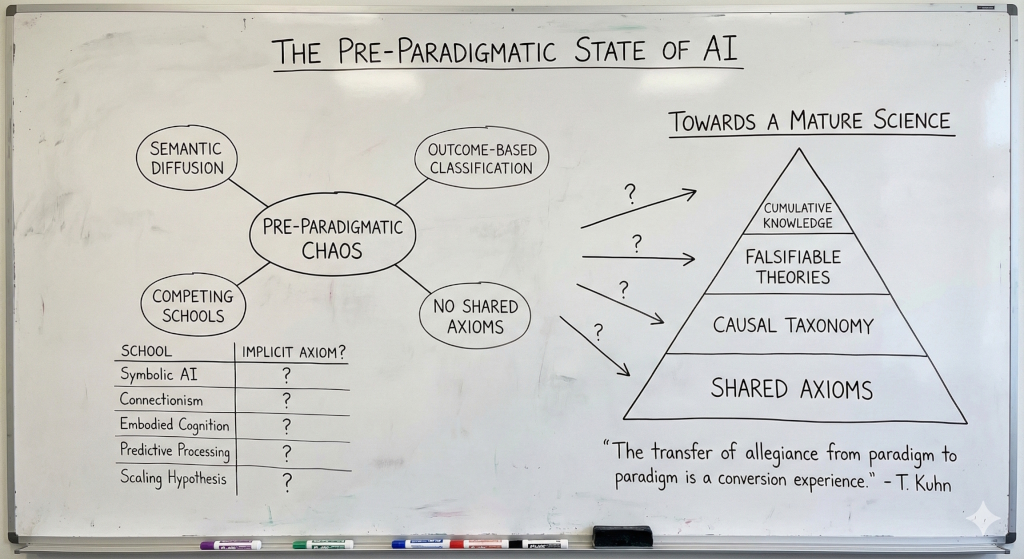
The artificial intelligence field is trapped in the same pre-paradigmatic state that has plagued cybersecurity: semantic diffusion, competing schools with incompatible axioms, and outcome-based classification that obscures causal understanding. We have more compute, more researchers, and more funding than ever — yet we cannot agree on what “intelligence” means. This isn’t a measurement problem. It’s a foundations problem.
The world of artificial intelligence is caught in a familiar paradox: we have more compute, more researchers, and more funding than ever before — yet we cannot agree on what we are building. Ask ten AI researchers what “intelligence” means and you will get twelve answers. Ask them what “reasoning” is, what “understanding” entails, whether current systems “think,” and the disagreements multiply.
The usual explanation is that AI is simply young, that definitions will converge as the field matures. But what if the problem runs deeper? What if AI, like cybersecurity, is trapped in what Thomas Kuhn called the pre-paradigmatic phase — the state of a discipline before it becomes a science?
The Symptoms of Pre-Paradigmatic AI
Kuhn observed that young sciences share characteristic symptoms: competing schools, fragmented terminology, brilliant practitioners who cannot build on each other’s work because they lack shared foundations. AI exhibits all of these.
Fragmented Terminology: What does “intelligence” mean? OpenAI, Anthropic, DeepMind, and academic researchers use the term constantly — but with fundamentally different implications. “AGI” has become almost meaningless through overuse. “Reasoning,” “understanding,” “emergence” — each term carries implicit theoretical commitments that are rarely made explicit.
Competing Schools Without Shared Axioms: The field contains multiple research traditions, each with its own foundational assumptions about what intelligence is:
| School | Implicit axiom |
|---|---|
| Symbolic AI | Intelligence = manipulation of structured representations |
| Connectionism | Intelligence = statistical pattern extraction |
| Embodied Cognition | Intelligence = sensorimotor coupling with environment |
| Predictive Processing | Intelligence = prediction error minimisation |
| Scaling Hypothesis | Intelligence = compression + compute |
These schools are not arguing about data. They are arguing about what the thing is at a foundational level. Their debates often reduce to definitional confusion masquerading as substantive disagreement.
The Measurement Problem: We cannot agree on what benchmarks measure. MMLU, ARC, HumanEval, GSM8K — each captures something, but there is no shared framework for what “capability” means at a foundational level. We are in a state where “GPT‑4 scores 90% on X” tells us almost nothing about whether the system actually understands anything, because “understands” is not defined.
Outcome-Based Classification: We classify AI systems by what they produce — “generates text,” “generates images,” “plays games” — rather than by the underlying computational mechanisms. This mirrors cybersecurity’s habit of classifying by outcomes (“ransomware,” “data breach”) rather than causes (the generic vulnerability being exploited).
“The transfer of allegiance from paradigm to paradigm is a conversion experience that cannot be forced.” — Thomas Kuhn
Why This Isn’t Physics
Physics operates within settled paradigms. It has shared axioms, mathematical formalism, reproducibility criteria, and a community that agrees on what constitutes evidence and explanation. When physicists disagree, they disagree within a framework that makes disagreement productive.
AI has none of this settled. We are pre-Newton, not post-Einstein.
Foundational gaps
Without answers to these questions, AI researchers cannot build on each other’s work in the way that mature sciences do. Each lab develops its own terminology, its own benchmarks, its own implicit theories of mind. They observe the same systems — but they cannot combine their observations into cumulative knowledge.
The Philosophical Parallels
Popper: Falsifiability
Karl Popper argued that a theory is only scientific if it is falsifiable — if there exists some possible observation that would prove it wrong. Apply this to AI claims: What would falsify the statement “GPT‑4 reasons”? What experiment could we run? The fact that we cannot clearly answer this question suggests that “reasons” as currently used is not a scientific concept — it is too vague to be tested.
Carnap: Broken Language
Rudolf Carnap devoted his career to building languages in which misunderstandings become structurally impossible. He would diagnose AI’s semantic diffusion as a symptom of insufficiently formalised language. When “intelligence” means different things to different researchers, what is missing is not expertise — it is a shared grammar.
Quine: The Web of Beliefs
Willard Van Orman Quine argued that no statement can be verified in isolation — our beliefs form an interconnected web. When an AI system behaves unexpectedly, is it the training data? The architecture? The reward function? Without a foundational taxonomy, we cannot even name the nodes in the web.
The Cybersecurity Parallel
Cybersecurity faces — and is beginning to address — the same structural problem. The TLCTC Framework demonstrates what a foundational taxonomy looks like: classification by generic vulnerability rather than by outcomes, enabling comparability, precision, and diagnosis before therapy.
The Question Nobody Asks
We have brilliant researchers, massive compute, and unprecedented funding. We have systems that produce remarkable outputs.
What we do not have is agreement on what these systems are or what they do at a foundational level.
What a Foundational Taxonomy Might Require
A paradigm for AI would need to establish axioms (conservation-like starting points), precise specifications (not dictionary definitions), mechanism-based classification (search vs. optimization), and rigid falsifiability criteria.
Addendum: On Non-Determinism
One might object that AI systems are non-deterministic in ways that make causal taxonomy impossible. But cybersecurity faces the same challenge: social engineering exploits universal cognitive patterns, yet any specific outcome is stochastic. The generic vulnerability can still be classified even when specific outcomes vary.
References
- Kuhn, T. S. (1962). The Structure of Scientific Revolutions.
- Popper, K. (1959). The Logic of Scientific Discovery.
- Carnap, R. (1934). The Logical Syntax of Language.
- Quine, W. V. O. (1951). Two Dogmas of Empiricism.
- Kreinz, B. (2025). The End of Semantic Diffusion.